
Shopify Incident Intelligence
opsdeck
Stop debugging Shopify incidents for hours.
opsdeck builds an evidence-based timeline for every order, webhook and fulfillment event — then its AI incident engineer explains what broke, why it broke, and what to do next.
Live on the Shopify App Store
By the numbers
4
stages: incident, evidence, diagnosis, resolution
30/90/180
days of retention by plan
5
families of alerts
1 click
to install, operations read-only
What it is
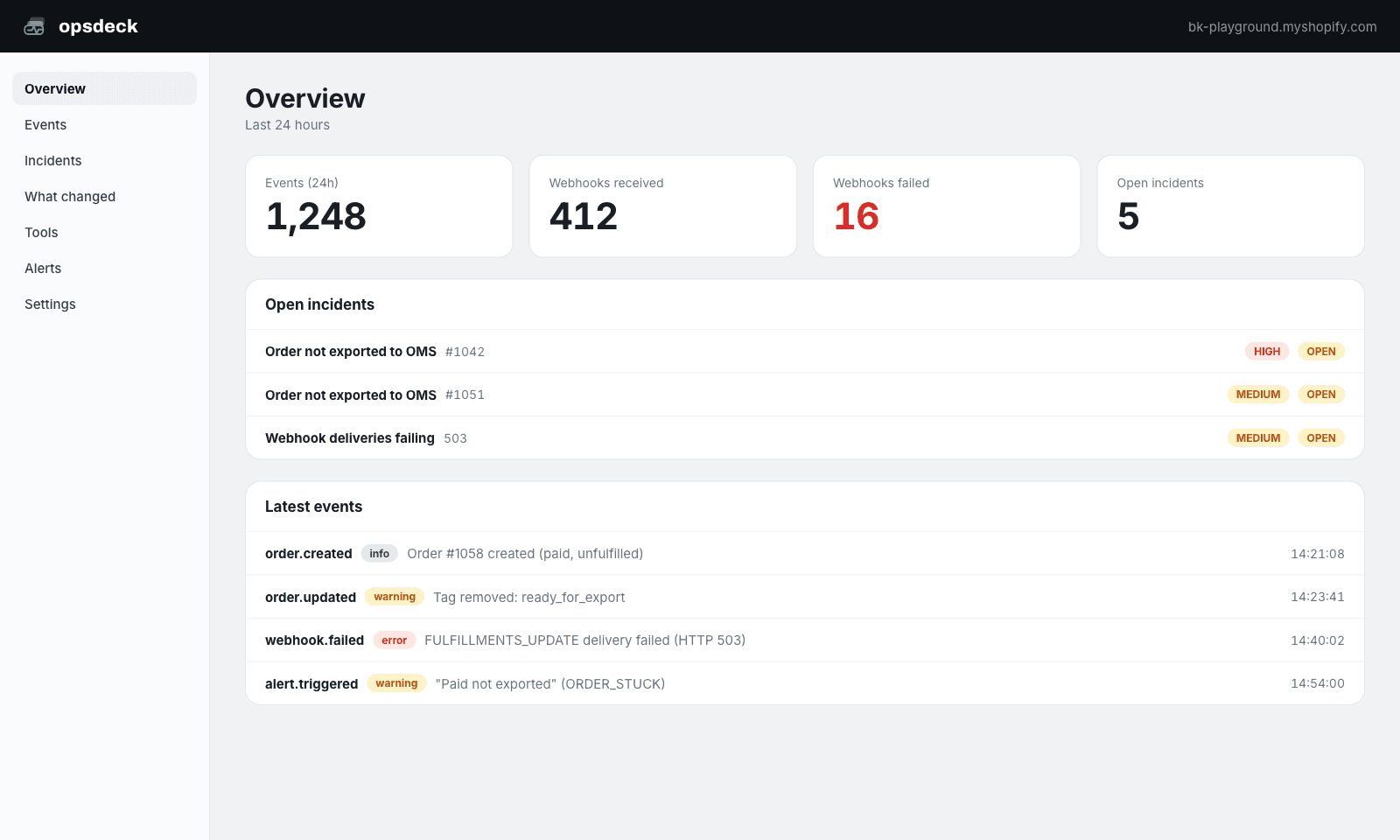
opsdeck normalises every webhook and operational event in your store into a single readable, timestamped technical timeline. When an order gets stuck, a webhook fails or a fulfillment never moves, you no longer rebuild the sequence by hand across the Shopify admin, OMS logs and a Slack thread: the story is already there, in order.
On top of that timeline sits an AI incident engineer that reasons only over events that actually happened. It returns the probable cause, how to verify it, the suggested fix, the risk level and the systems involved — never a guess pulled from thin air, always with the evidence attached.
The problem
One paid order that never reaches the OMS can cost you an afternoon.
In stores that actually run, failures are rarely dramatic: a tag removed by an app, a webhook that quietly stops responding, a fulfillment that sits still. The time doesn't go into fixing the problem — it goes into working out what happened, hopping between admin, logs, third-party dashboards and whoever noticed first. opsdeck compresses that phase into a single read.
What it does
Resolution playbook
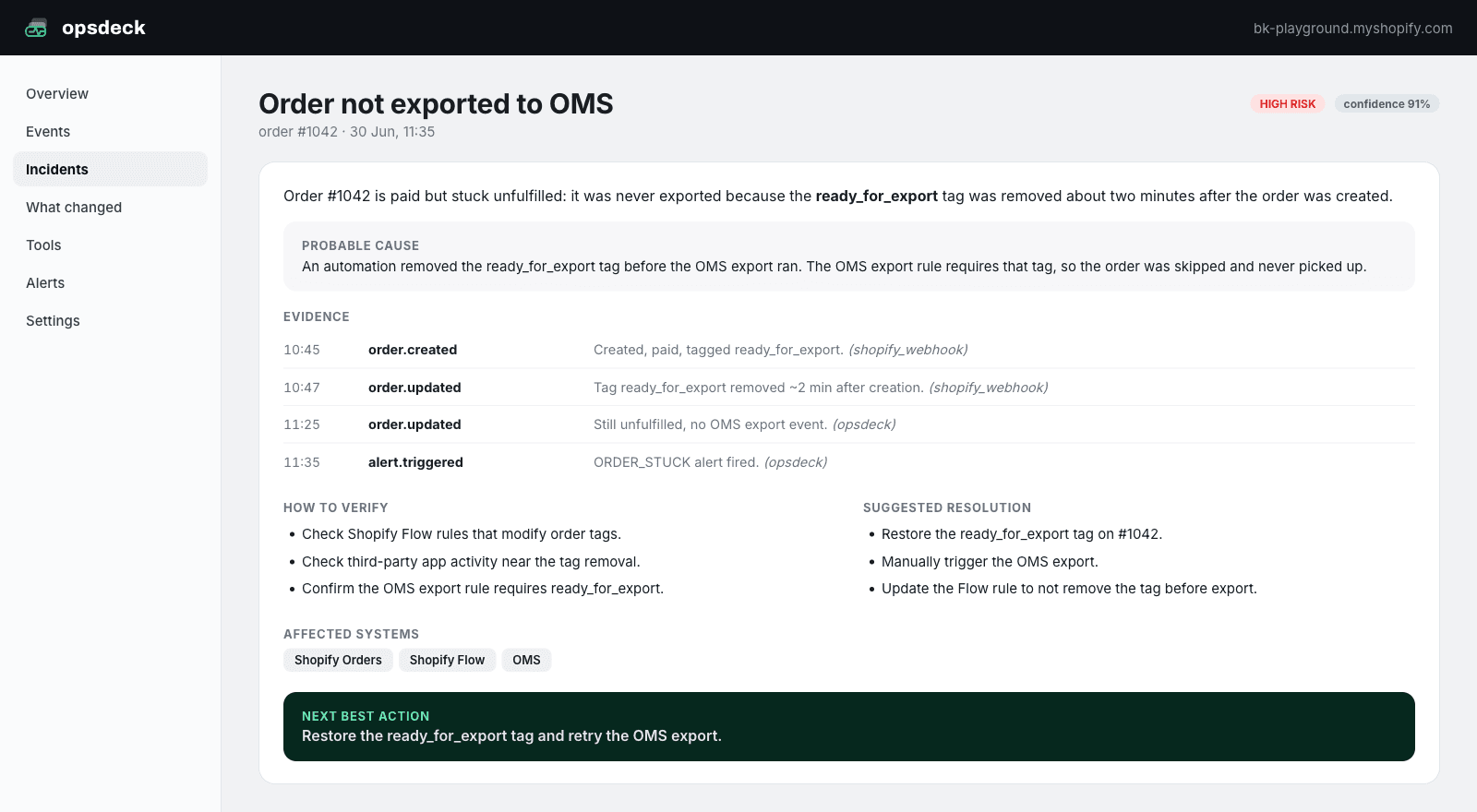
Probable cause, supporting evidence, how to verify, suggested fix, risk and next action. All anchored to real events: when the data isn't there, the AI says so instead of inventing it.
Timeline per order
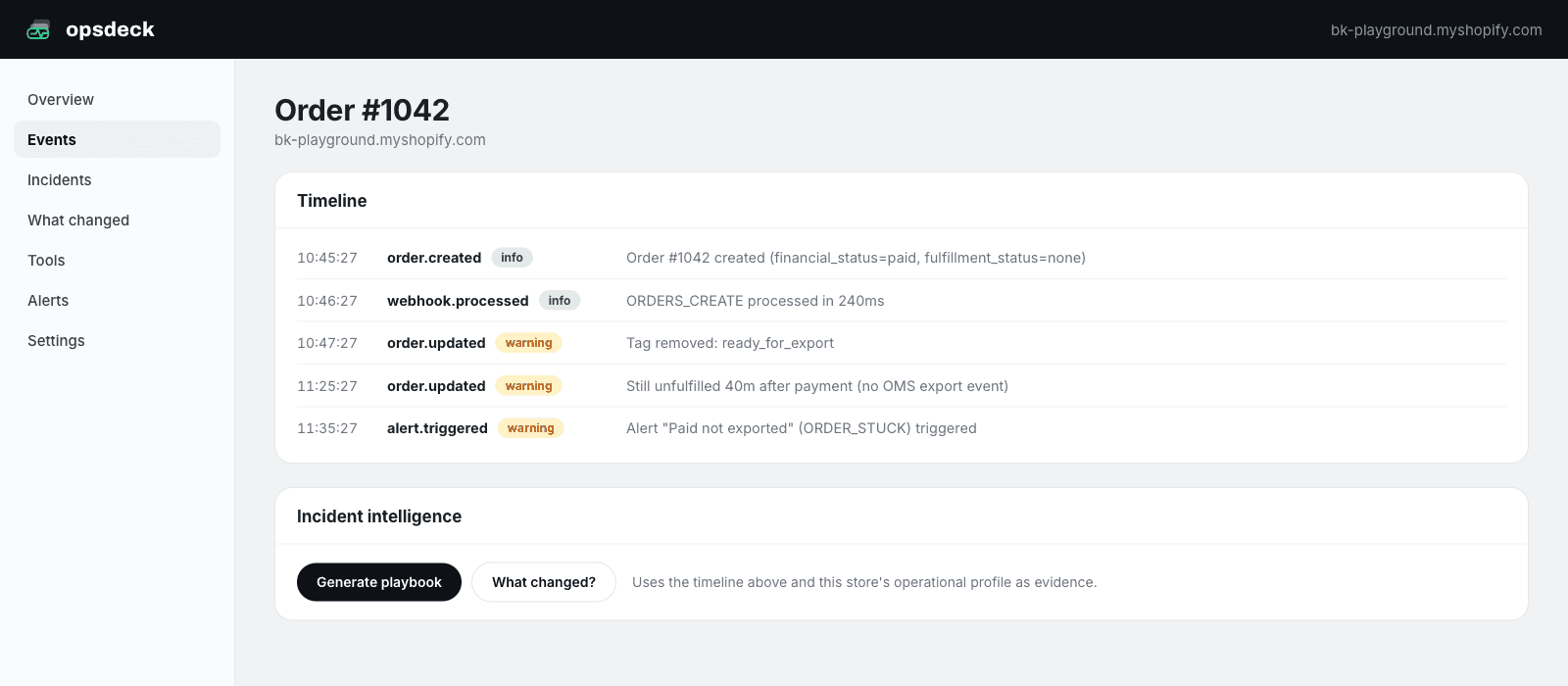
A readable technical history — created, webhook, tag changes, fulfillment — in the exact order it happened, with a timestamp on every step.
What changed?
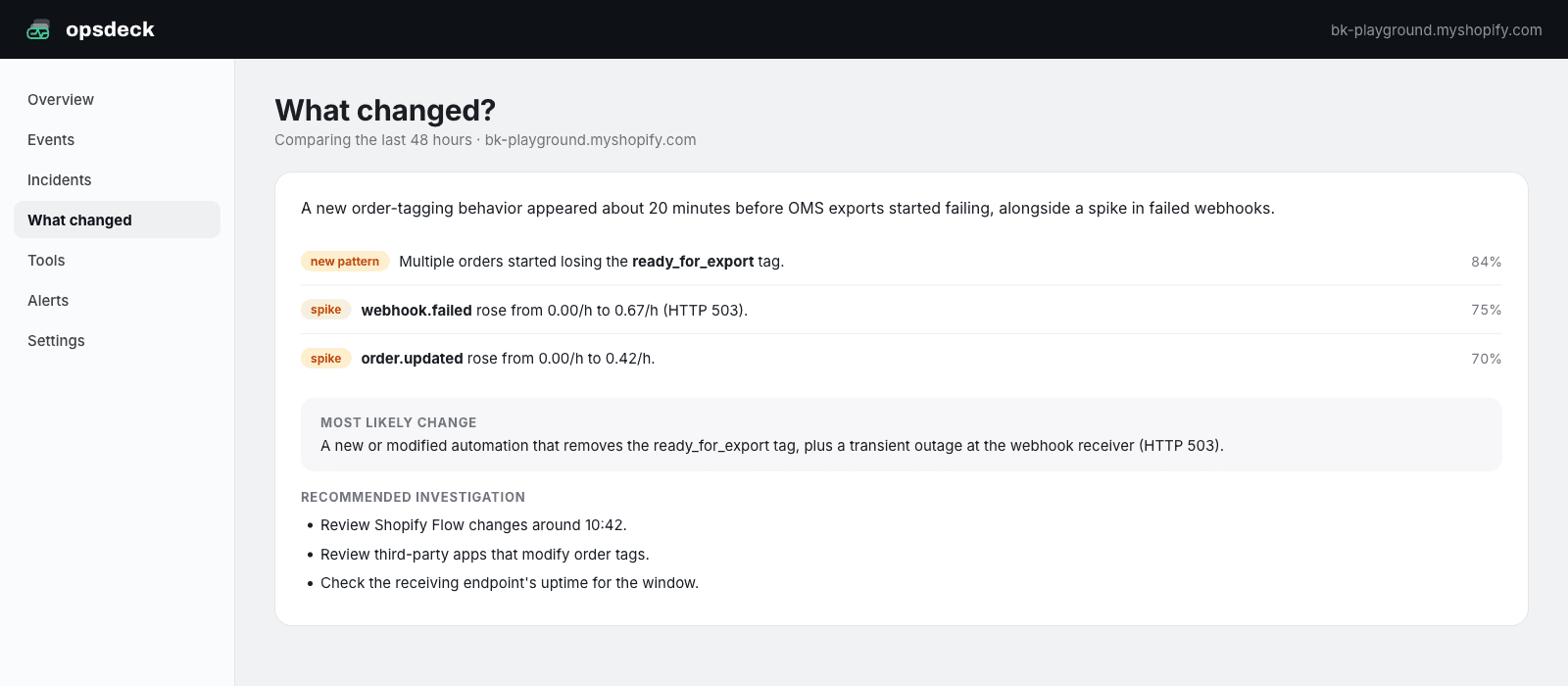
Compare the state before and after an incident to surface the difference: new tag behaviour, an error spike, an app installed last week.
Blast radius and history
How many orders share the same failure, and whether this incident has happened before. It separates the one-off from the systemic problem immediately.
Smart alerts
Rules for stuck paid orders, failed webhooks, fulfillment delays, payment anomalies and inventory sync issues — before your customers notice.
Privacy by design
Protected customer fields are stripped before storage and never sent to the AI. Events auto-delete when your plan's retention window expires.
How it works
- 01
Incident
Something breaks — a stuck order, a failed webhook, a fulfillment that never moves, a tag quietly removed by an app.
- 02
Evidence
Every webhook and operational event is normalised into one readable, timestamped technical timeline.
- 03
Diagnosis
The AI incident engineer explains the most probable cause using only the events that actually happened.
- 04
Resolution
An operational playbook: how to verify, the suggested fix, the risk level, the systems affected and the next best action.
The product
Who it's for
Ops and customer care teams
Whoever gets the report first and has to tell within minutes whether it's a single case or the start of a wider incident — without opening a ticket with engineering.
Developers and system integrators
Whoever maintains the OMS, ERP and WMS integrations and needs evidence, not anecdotes, when deciding which side of the boundary the problem started on.
Multi-store agencies
Teams running many Shopify Plus stores who want one place to look when a webhook flow goes quiet.
The technical choice
A Barikreativa product: design, architecture and full-stack development in-house. Published on the Shopify App Store.
Works with
Pricing
Starter
$19/mo
For a single store getting visibility.
- 30-day event retention
- 20 AI diagnoses per month
- Up to 3 alert rules
- Order timelines and dashboard
- Email support
Pro
$99/mo
For growing stores that can't go dark.
- 90-day event retention
- 200 AI diagnoses per month
- Unlimited alert rules
- Advanced alerts on payments and sync
- Email support
Agency
$199/mo
For teams running many stores.
- 180-day event retention
- Unlimited AI diagnoses
- Unlimited alert rules
- Advanced alerts
- Priority support
All plans bill in USD through Shopify. AI diagnoses reset monthly and events auto-delete after the retention window. One prevented stuck-order incident usually covers the month.
Frequently asked questions
- Do I need to write code to install it?
- No. opsdeck is an embedded Shopify admin app: one-click install, session-token auth, and every webhook HMAC-verified. It doesn't touch your theme and needs no snippets.
- What data does it store?
- Operational events: orders, webhooks, fulfillments, tag changes. Protected customer fields are stripped before storage and are never sent to the AI model.
- How long are events kept?
- It depends on the plan: 30 days on Starter, 90 on Pro, 180 on Agency. Once the window closes, events are deleted automatically.
- Can the AI invent a cause?
- The diagnosis is bound to the events present in the timeline. If the evidence isn't enough for a conclusion, the playbook says so and tells you what to check, rather than producing a plausible but unsupported story.
- Does it work with external OMS, ERP and WMS?
- Yes. opsdeck sits on top of the stack you already run: it correlates Shopify events with downstream systems and shows where in the chain the flow broke.
- How is it different from Shopify's native alerts?
- Shopify tells you a webhook delivery failed. opsdeck tells you which orders it hit, whether it happened before, what changed right beforehand, and which fix to apply.
Put opsdeck to work on your store
Designed, built and maintained by our own team. If you need a hand fitting it into your stack or customising it, we do that too.